
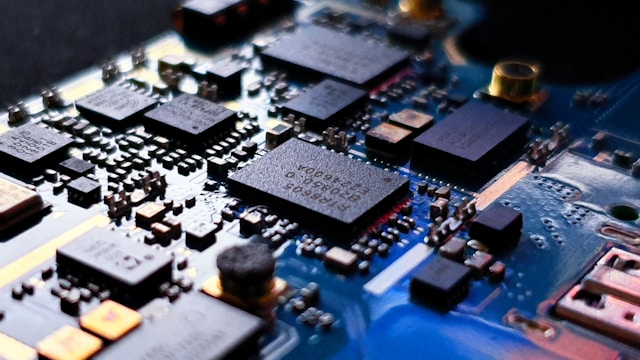
The first electronic computers were not sleek laptops or even desktop machines—they were room-sized behemoths that consumed enough electricity to power a small town. They were built with thousands of fragile vacuum tubes, miles of wiring, and complex punch-card systems. Yet these machines represent the true beginning of the digital age.
ENIAC: The First General-Purpose Electronic Computer
ENIAC (Electronic Numerical Integrator and Computer) was developed during World War II by John Presper Eckert and John W. Mauchly at the University of Pennsylvania. Completed in 1946, it was the first fully electronic, general-purpose digital computer .
ENIAC was a technological marvel for its time, but also a monument to scale:
- Size: 1,500 square feet of floor space
- Weight: Approximately 30 tons
- Vacuum tubes: 18,000 to 19,000 tubes
- Power consumption: 180,000 watts
- Speed: Could perform 300 multiplications per second
ENIAC was built to calculate artillery firing tables for the US Army, but its first major public demonstration was used to calculate hydrogen bomb feasibility . Because its programs were “hard-wired,” reprogramming required physically rewiring the machine with patch cables and switches—a painstaking process that could take days .
EDVAC and the Stored Program Concept
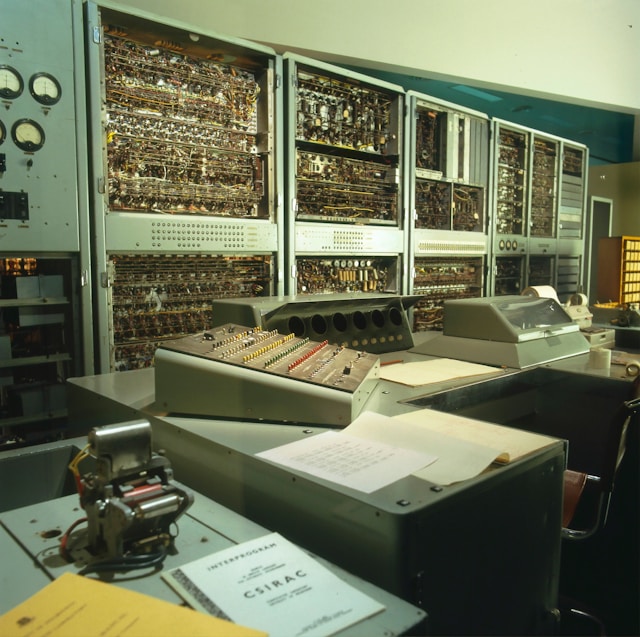
While ENIAC was revolutionary, it had a major limitation: each new task required physical rewiring. The solution came from John von Neumann, who in 1945 wrote the “First Draft of a Report on EDVAC” . His proposal introduced the stored-program concept—the idea that a computer’s program could be stored in its memory in the same way as data .
EDVAC (Electronic Discrete Variable Automatic Computer) was built by Eckert, Mauchly, and von Neumann . It was completed in 1949 and was the first computer to use the von Neumann architecture, which remains the basis for virtually all modern computers: CPU, memory, storage, communication bus, and peripherals .
UNIVAC: The First Commercial Computer
While ENIAC and EDVAC were built for government and military purposes, UNIVAC I (UNIVersal Automatic Computer I) was the first computer designed for commercial use . Introduced in 1951, it was built by Eckert and Mauchly for the US Census Bureau .
UNIVAC made history in 1952 when CBS used it to predict the presidential election results. The computer correctly predicted Eisenhower’s landslide victory, but network executives were so skeptical of the machine that they withheld the results until after the election was called .
The Legacy of the First Generation
These early computers—ENIAC, EDVAC, and UNIVAC—established the foundational principles of computing that we still use today. Their development was accelerated by wartime needs, but their impact extended far beyond military applications. They proved that electronic computing was not just possible, but commercially viable.
Conclusion: From Room-Sized to Pocket-Sized
The first electronic computers were expensive, power-hungry, and physically enormous. Yet they demonstrated that machines could perform complex calculations faster than any human. Within decades, advances in transistors and integrated circuits would shrink these room-sized behemoths into devices that fit in our pockets—but the principles of operation remain remarkably similar to what von Neumann and his contemporaries envisioned in the 1940s.