
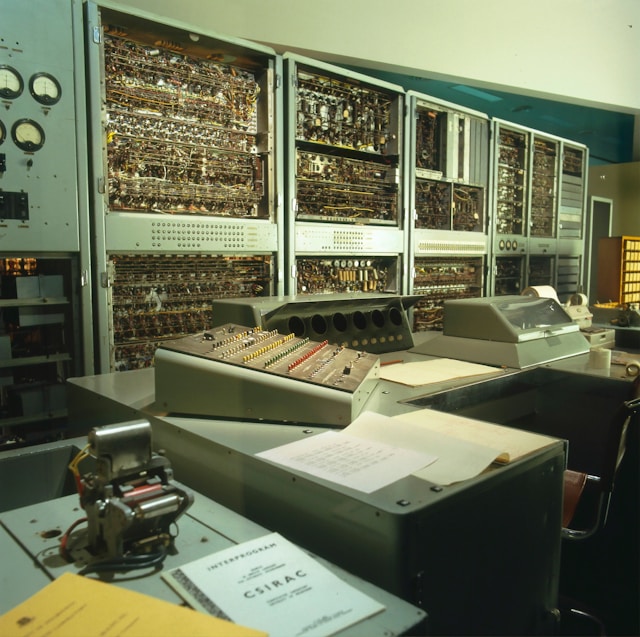
The history of computers is one of the most remarkable stories of human achievement. It is a tale spanning thousands of years, from simple counting tools to machines that can beat grandmasters at chess and drive cars autonomously. Understanding this history is essential to appreciating the technology that now permeates every aspect of modern life.
Ancient Foundations: The First Calculating Devices
The story begins long before electricity or silicon chips. The first known calculating device, the abacus, was invented in Mesopotamia around 3000 BCE and later used in China, India, and other Asian countries . This simple wooden rack with beads strung on wires allowed users to perform arithmetic operations efficiently.
Around 300 BCE, Indian mathematician Pingala invented the binary number system, which would become fundamental to modern computing . In the first century BCE, the Antikythera mechanism, an ancient Greek analog computer, was built to track astronomical positions .
The Mechanical Revolution
The 17th century marked the beginning of mechanical computing. In 1614, Scottish mathematician John Napier developed a primitive form of slide rule known as “Napier’s bones,” used to calculate logarithms . In 1642, Blaise Pascal created the first mechanical adding machine, the Pascaline, designed to help his father, a tax collector .

In 1671, Gottfried Wilhelm von Leibniz invented a more advanced mechanical calculator that could add, subtract, multiply, and divide . Leibniz also developed the stepped gear mechanism that remained in use for centuries.
Babbage and the First Computer Concept
The most significant leap came in the 1830s when Charles Babbage designed the Analytical Engine, the first concept of a general-purpose computer . The machine could store information, make decisions, and carry out instructions based on its decisions. It was to be programmed using punched cards—an idea borrowed from the Jacquard loom of 1801, which used punched cards to control weaving patterns .
Ada Lovelace, who worked closely with Babbage, is widely regarded as the first computer programmer for writing algorithms intended for the Analytical Engine . In 1890, Herman Hollerith used punched cards for the US Census, and his company eventually became IBM .
The Electronic Era Begins
The first fully electronic computers emerged in the 1940s. In 1946, John Presper Eckert and John W. Mauchly completed ENIAC (Electronic Numerical Integrator and Computer), which used 19,000 vacuum tubes, occupied 1,500 square feet, and consumed 180,000 watts of power . In 1945, John von Neumann proposed the stored-program concept, where a program is stored in memory alongside data—the foundation of modern computer architecture .
Transistors, Integrated Circuits, and the Microprocessor
The invention of the transistor in 1947 revolutionized computing. Transistors replaced bulky, unreliable vacuum tubes, making computers smaller, faster, and cheaper . The IBM 7090 in 1958 was the first computer to use transistors .
The integrated circuit, invented independently by Jack Kilby and Robert Noyce in 1958, allowed thousands of transistors to be placed on a single chip . In 1971, Intel introduced the first microprocessor, placing an entire CPU on a single chip . This enabled the personal computer revolution.
The Modern Era: PCs, the Internet, and AI
The 1975 Altair 8800 was the first kit microcomputer, followed by the Apple II in 1977 and the IBM PC in 1981, which dominated business computing . The ARPANET, launched in 1969, evolved into the modern Internet . The World Wide Web was introduced to the public in 1991, transforming how we share information .
Today, artificial intelligence, quantum computing, and cloud technologies represent the latest chapters in this ongoing story. The history of computing is far from over.