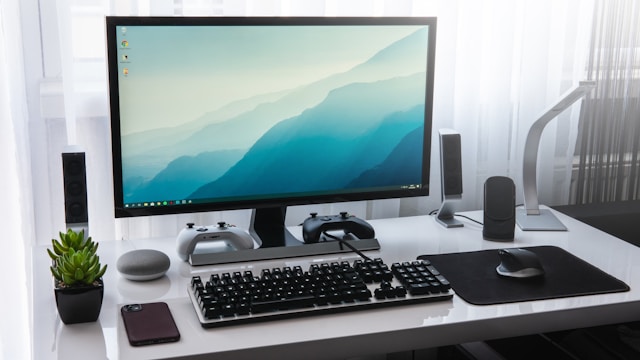
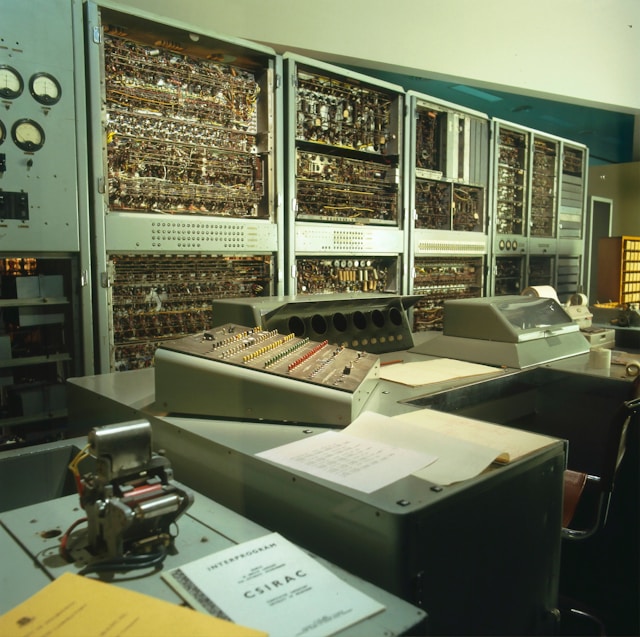
For decades, computers were the exclusive domain of governments, universities, and large corporations. They were expensive, room-sized, and required expert operators. The personal computer (PC) revolution changed all that. Suddenly, individuals could own a computer, use it at home, write their own software, and connect to a growing world of information.
1975: The Altair 8800 and the Birth of the PC
The Altair 8800, introduced in 1975, is widely considered the first personal computer . It was sold as a kit by MITS for $395 with 256 bytes of memory and no screen, keyboard, or disk drive . You programmed it by flipping switches on the front panel.
The Altair was primitive, but it sparked a revolution. Two young entrepreneurs, Paul Allen and Bill Gates, wrote a BASIC interpreter for the Altair and founded Microsoft—the beginning of one of the most influential companies in computing history .
1976–1977: Apple, Commodore, and Tandy
In 1976, Steve Wozniak and Steve Jobs founded Apple Computer . In 1977, they released the Apple II, the first truly successful personal computer . The Apple II was factory-built, user-friendly, and capable of color graphics. It was the first PC to become widely adopted by consumers and businesses.
Also in 1977, Commodore released the PET and Tandy/Radio Shack released the TRS-80. These three machines—the Apple II, PET, and TRS-80—are often called the “1977 Trinity” of personal computers .
1981: The IBM PC Enters the Market
The personal computer market changed forever in 1981 when IBM introduced its IBM Personal Computer (PC) . IBM, the dominant force in business computing, legitimized the PC market and established the architecture that would define the industry.
The IBM PC used an Intel 8088 processor and ran MS-DOS, an operating system from Microsoft . Because IBM published the technical specifications, “IBM-compatible” clones emerged, creating a massive ecosystem of software and hardware. This established the Wintel (Windows + Intel) dominance that would last for decades .
1984: Apple’s Macintosh and the GUI Revolution
In 1984, Apple introduced the Macintosh, the first widely available computer with a graphical user interface (GUI) featuring icons, windows, and a mouse . While not the first GUI (Xerox PARC’s Alto in 1973 had pioneered the concept), the Mac made it mainstream .
Microsoft released Windows 1.0 in 1985, and by 1990 with Windows 3.0, the GUI became standard on PCs . Apple sued Microsoft over the similarity of Windows to the Mac OS, but Microsoft’s dominance in the PC market was by then unassailable .
1980s–1990s: The PC Boom
The 1980s and 1990s saw the PC market explode. The Commodore 64 (1982) became the best-selling computer of all time . The IBM PC/AT (1984) and IBM PS/2 (1987) continued to set standards . Windows 95 was a massive success, making the PC accessible to millions of new users .
The Modern PC Era
Today, the PC market includes desktops, laptops, and tablets. Apple’s Mac line, Microsoft’s Windows, and various Linux distributions coexist. The rapid pace of innovation continues, but the fundamental architecture established in the 1980s remains recognizable. The personal computer, once a dream, is now an essential tool for billions of people around the world.
Conclusion: The Democratization of Computing
The history of personal computers is a story of democratization—of bringing computing power out of government labs and into homes and hands. From the Altair’s blinking lights to the sleek devices of today, the PC revolution has empowered individuals to create, communicate, and compute like never before.